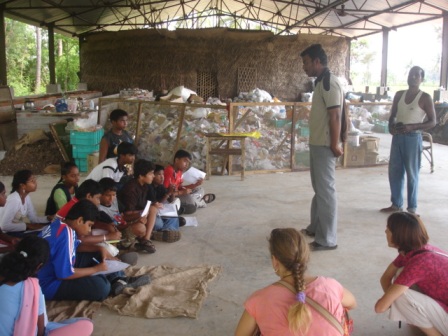
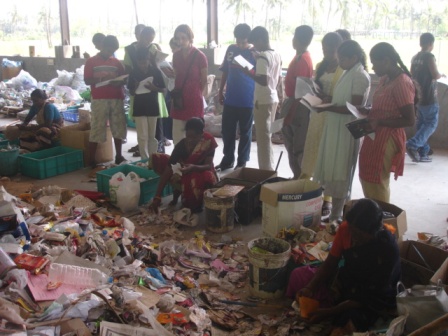
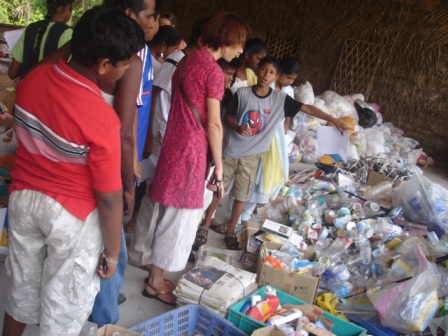
Watch the new Shuddham video, celebrating the wonderful work done by the Shuddham “Beautifiers” to help keep Pondicherry’s Raj Bhavan neighborhood clean and to help create a model for urban waste management that can reverse the epidemic of filth that plagues India.
Where most people see trash, Shuddham sees opportunity; so it was only natural that fashion designer Anjali Schiavino would turn to Shuddham with her problem. Anjali was making an exclusive line of organic cotton clothing for a European client and wondered if there was a constructive use to which the pattern trimmings could be put. Thanks to our friend Anshu Gupta, we came up with an answer which Anjali immediately proclaimed as, “super cool!”
This weekend, Shuddham participated in the National Workshop on Environmental Policy Integration for Greening the Indian Economy at Pondicherry University. We were asked to present a paper and give a presentation on approaches to policy development for solid waste management.
Construction of the new resource center is well underway, and Phase I should be completed by April. The center will contain discrete areas for secondary sorting of inorganic waste for recycling, conventional composting, vermicomposting, and research and development. In this latter section, we will be looking at high-value ways of extracting value from our waste streams, preferably right here within our community.
The fuel briquetting experiments are one example of our R&D efforts; studying the feasibility of replicating Goonj’s Not Just a Piece of Cloth program for the reuse of scrap cotton from local clothing companies is another.
Research is underway here at Shuddham to explore the feasibility of converting a portion of our segregated waste stream (principally paper, cardboard, and sawdust) into biomass fuel briquettes. Early prototypes, pictured above, were formed under consdierable pressure using an old motorcycle cylinder and piston, and a hydrolic press.
A more traditional forming-and-drying method is also being tested.
The formulations are being combustion-tested at Aprovecho Research Center — the world’s leading experts in biomass cookstove engineering — to ensure that the briquettes do not give off undue quantities of carbon monoxide and harmful particulates when burned.
Biomass remains the most common cooking fuel in the villages of India — including those around Pondicherry. In fact, most of the Shuddham “Beautifiers” use biomass cookstoves in their own kitchens. It would be a nice re-use of our combustible waste stream to create cooking fuel.
Today, Shuddham officially took over garbage collection for the rest of Raj Bhavan (excluding the Park but including Beach Road) - covering most of “white” (or “French”) Pondicherry. In fact, we started last night by picking up three tractor loads worth of garbage from the new area to be covered (the area south of the Park), but that was not enough for us to start off with a clean (so to speak) slate - the streets had not been properly cleaned for a week.
One of the typical streets south of the Park this morning
Yesterday, we contracted additional tractor pick-ups, interviewed for two new supervisors, and tried to hire back-up workers in case the women already working for the other company didn’t want to work for Shuddham. (We want to give all the current employees of the former contractor an opportunity to keep their jobs.) The volunteer members of Shuddham went to speak with some of the residents and hotels in the area personally to inform them that we would be instituting a new system soon and to please not throw their waste onto the streets - we would come and pick it up.
Today, none of the other workers showed up for work. They were busy protesting the termination of their previous employment when they haven’t been paid for 5 months. Somehow, with a skeletal staff, no additional supervisors, and a backlog of garbage in the streets, the existing workers managed to clean most of the streets. A ride-by this evening showed a marked contrast to the situation this morning. It’s amazing what a daily pick-up of garbage will do for a city!
We won’t institute the recycling program until we are at full staff and all the systems have been put in place. (Our three new tricycles were delivered this evening.) Then, volunteers will go door-to-door with the new posters designed by Tony and Kyle and other education material and ask all the households and institutions in the area to segregate their garbage.
Policarpio (Tony) Soberanis and Kyle Sieck, students at the University of Iowa (UI), are here working with Shuddham as part of UI’s three-week “Social Entrepreneurship in India” study abroad program.
Tony is a PhD student in Industrial Engineering and Kyle is finishing up his last year as an undergraduate in Geography and Philosophy.
I grew up in Belize, Central America, where I worked with my mother, trying to help the citizens of the largest city change their attitude toward the freedom that we have to throw our garbage anywhere we please. We had great success. Now, I am a PhD student in Industrial Engineering at the University of Iowa and I would like to use all the knowledge that I have amassed along with the values that have been instilled in me by my mother to help wherever I can.
A few reasons why I have come to India are 1) I wanted a service learning experience in another country, 2) I wanted to offer my perspectives on sustainability and greening cities, 3) I find Indian culture and Eastern philosophy very interesting, and 4). I’m interested in tropical agriculture and growing food in densely populated areas.I expressed interest in working with Shuddham because I like their mission of “Rediscovering Hamony” and I like how their work seeks to improve the quality of live through improving the local environment. Shuddham’s philosophy is in line with my own ethics and I hope to help them out as much as I can.
Tony and Kyle have been working with Shuddham on a number of education and advocacy projects, including:
Working with the NSS students of Tagore Arts College to plan an awareness generation campaign against littering on Beach Road on the weekends
Designing an educational poster about the segregation of garbage for students and households in Pondicherry
Adapting existing police barricades (used to block cars and other wheeled vehicles to make Beach Road pedestrian only every evening) and designing banners to promote a green, clean, and peaceful Pondicherry
The members of Shuddham started off the new year with the foundation stone (or in our case, brick) laying ceremony of the new Parivarthan Resource Center to be built west of the “Boulevard” town in Pondicherry. The Resource Center will include the recycling shed, vermi- and ordinary composting areas, and a section for research and development of new uses of recycled materials.
Rajamanikam is a final year student at Pondicherry University’s Department of Ecology and Environmental Science doing his thesis on community-based solid waste management. He is here at Shuddham for three months, from December to February, to conduct his field work. At the end of three months, Rajamani will have studied the current system of solid waste management handled by the Pondicherry municipality and compared it with the zero-waste model developed by Shuddham.
Current system:
Rajamani will examine the size of the municipal dumps and survey the area surrounding the dumps, including the health of the tribal population alloted space in the area and ground water quality.
Shuddham system:
In the area currently covered by Shuddham, Rajamani is conducting a household survey of the 482 homes in the 15 streets north of the Park in the Raj Bhavan ward of Pondicherry. Survey questions include:
How many people in the home
How much waste they household generates a day
Whether they are segregating the waste
If so, do they know why they are segregating?
If not, they are given an education on segregation.
Initial survey results indicate that 50% of the households are currently segregating. A return visit indicates that 30% of the non-segregating households are now segregating following the education by Rajamani.
Rajamani will also study the volume of recyclables collected, by type (e.g. how much of the dry waste is paper, polyethylene bags, medical waste, etc.) and assess an economic value to the waste-turned-resource.
Rajamani’s household survey will be invaluable for Shuddham, as they strive to make all households in their service area compliant.
Shuddham produces vermicompost from the garden and kitchen waste that it collects from households that segregate their garbage. Vermicompost is a much richer nutrient than ordinary compost (without worms), and is sold through word-of-mouth to gardeners in Pondicherry.
The worms
Vermicompost is basically worm castings (or worm shit). When fully established, worms will eat their body weight in decomposing vegetable matter (and produce a lot of manure).
Castings
The worms are bred in a moist bed covered with bricks and balls of cow dung. (The worms congregate under the bricks and dung balls.)
Breeding worms
Once the worms are established, they are moved to compost beds that are kept covered to keep out rodents and other insects.
Open compost bedClosed compost bed
Garden and kitchen waste is first shredded (to make things easier for the worms), then added to the compost beds.
Shredder
Vermiwash is collected, diluted, and sold separately as a plant nutrient.
Concentrated vermiwashDiluted and packaged vermiwash
A beneficiary of vermicompost and vermiwash
Waste is turned into a nutrient-rich natural fertilizer.